
What we consider a network
A group of repeaters or servers under shared administration, usually shown by coordinated talkgroups. Individual repeaters are not networks of their own; some scale in users or infrastructure is expected.
The app ships with maintained server and talkgroup lists for every network it supports, refreshed automatically every day. You choose from a list; you never hunt for an address or a talkgroup number.
| Mode | Networks and reflectors | In the lists today |
|---|---|---|
| DMR | BrandMeister, TGIF, DMR+, ADN, AmComm, HamUnited, DVSPh and XLX. Also DMR through the RF module of a supported radio. | Server and talkgroup lists, kept up to date |
| D-STAR | DCS and REF reflectors | Reflector lists, kept up to date |
| System Fusion | YSF reflectors | Reflector lists, kept up to date |
| P25 | P25 reflectors | Reflector lists, kept up to date |
| M17 | M17 reflectors, modules A to Z | Reflector lists, kept up to date |
| FM | Analog repeaters and simplex through the RF module of a supported radio, with a built-in repeater directory | FM and DMR repeater directory, kept up to date |
Lists change as the networks change. Some networks need your own account or password with that network, which you save in the User Portal.
Our servers refresh the server and talkgroup lists once a day, check which servers are alive, and keep the last good list if an update fails. When you pick a network, the app fetches the current list, with the nearest server first.
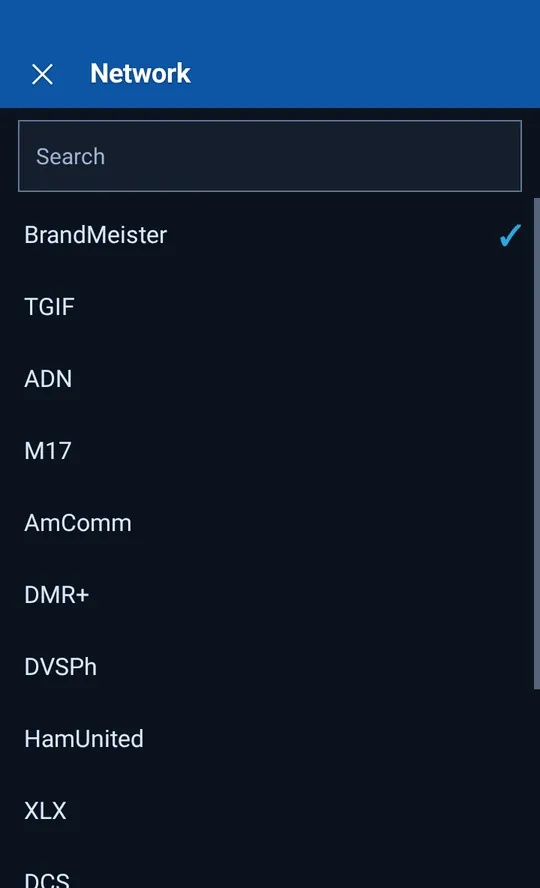
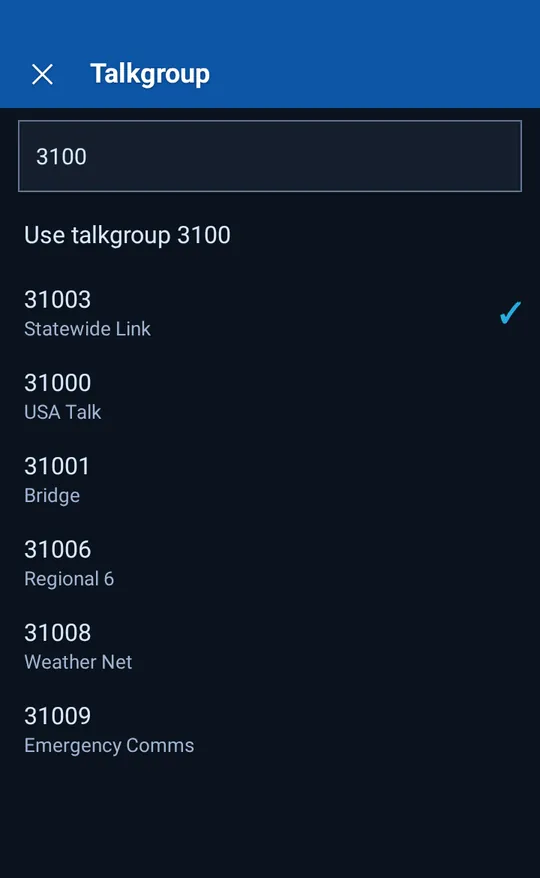
Choose a network, a server and a talkgroup (group or private call). Monitor extra talkgroups, and reply on your own TX talkgroup with one tap.
Pick a DCS or REF reflector and a module from the list.
Pick a YSF reflector. The server you pick is the destination, so there is no second step.
Pick a reflector. Its talkgroup comes with it.
Pick a reflector and a module letter, and switch modules from a call.
Through the RF module: frequencies, offsets, CTCSS and DCS tones, bandwidth, power and squelch, from your memories or the repeater directory.
Network voice is free: connect to the networks you love right from the app. FM, and DMR over the air, need a supported radio with an RF module.
We'd be glad to hear from you. We list both DMR/IP and DMR/RF networks in our directories, and we work directly with networks that want to take part.
A group of repeaters or servers under shared administration, usually shown by coordinated talkgroups. Individual repeaters are not networks of their own; some scale in users or infrastructure is expected.
The name you want shown, and a reliable public API with no attribution or commercial-use restrictions. We can help if you don't have one yet. We also ask for talkgroup 3161 for community and testing, though that part is optional.
Talkgroup number and description. For DMR/IP networks: server name or number, hostname or IP address, port and password. For DMR/RF networks: repeater ID, callsign or name, frequencies, color code, talkgroups per timeslot and location.
Requests must come from the network's administrators. Write to help at unifiedradios dot com and include:
Users: please ask your network's admins to contact us. We can't add a network on a user's request.